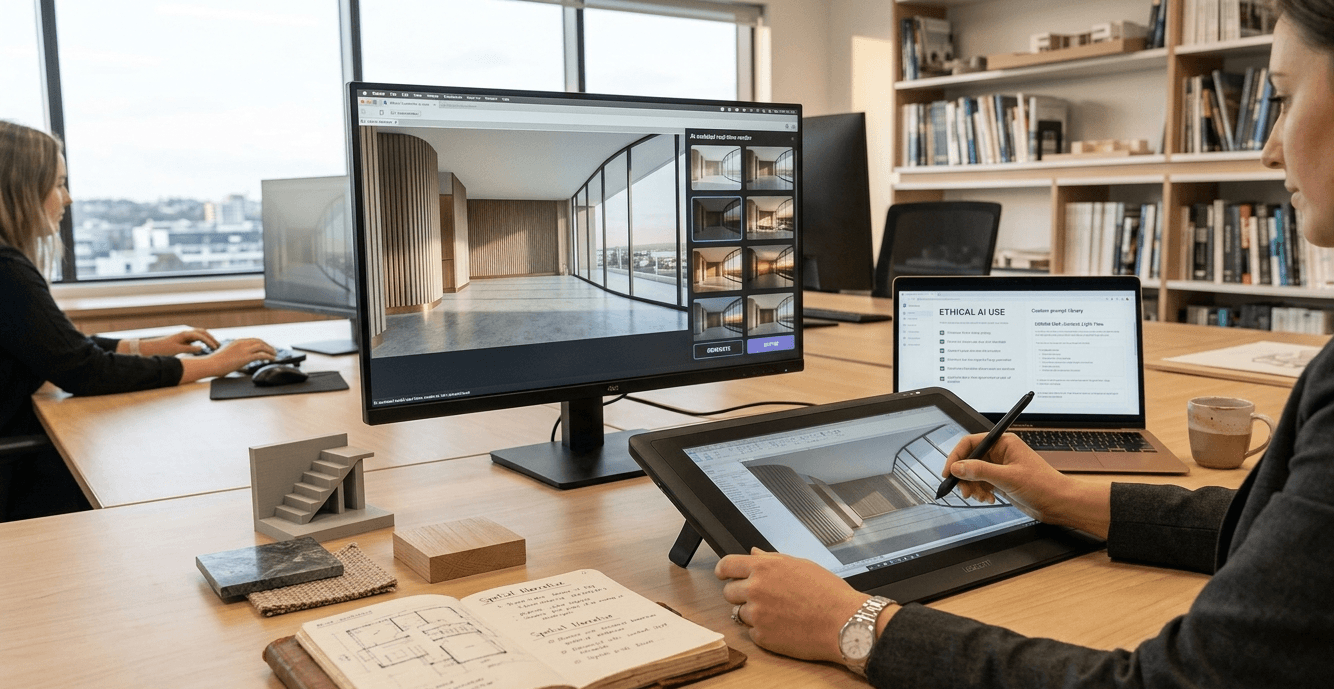

Walk into any design studio today and you'll likely find AI tools running alongside Vray, Lumion, Enscape, Photoshop, Revit, and SketchUp. From AI-generated interior renders and generative space planning tools to AI mood board generators and automated material specification software, the way spatial designers work has changed profoundly. But as these tools grow more capable, a critical question is rising through the profession: How do you use AI to work smarter without diluting the design intelligence that defines your practice?
For interior architects, your creative signature isn't just a visual style, it's a philosophy of how people should inhabit space. It's embedded in how you approach light, circulation, materiality, and the emotional experience of a room. The risk of leaning too heavily on AI-generated interior design concepts is that you end up producing spaces that feel familiar, derivative, and ultimately forgettable. The answer isn't to avoid these tools. It's to deploy them with intention, transparency, and a clear ethical framework.
What Does Ethical AI Mean for Interior Architects?
Ethical AI in interior architecture encompasses several dimensions: the transparency of your process with clients, the sourcing of training data used by the tools you rely on, questions of design authorship and IP ownership, and the broader impact on the profession, including junior designers whose learning pathways are being disrupted. But it also reaches into something more personal: the integrity of your design voice.
When an AI tool proposes a spatial layout, a finish palette, or a furniture composition, it's drawing on aggregated patterns from thousands of existing interiors. The output is statistically plausible, but it is not yours. Responsible AI use for interior designers means remaining the author of every meaningful design decision, using AI to accelerate and explore rather than to shortcut the thinking that makes great spaces possible.
"The best interior architects using AI right now aren't asking it what a space should look like. They're asking it to help them see faster, and then deciding for themselves."
The Homogenisation Risk in AI-Assisted Interiors
There's a reason so many AI-generated interior visualisations look eerily similar — all warm neutrals, limewash walls, fluted details, and arched openings. These tools are trained on popular, highly-shared imagery, which means they naturally gravitate toward what's already trending. If you use these outputs uncritically, you're not designing for your client's life and context. You're reproducing the visual median of the internet.
This is a genuine professional risk for residential interior architects, commercial space designers, hospitality design studios, and heritage renovation specialists alike. A hospitality project that looks like every other AI-conceived boutique hotel. A residential renovation that feels like a mood board aggregate rather than a considered home. Spatial design homogenisation doesn't just harm your reputation, it harms your clients, who deserve environments shaped around their specific needs.
How to Protect Your Design Voice
5 Principles for Style-Safe AI Use in Interior Architecture
Develop your concept brief, spatial narrative, client requirements, site response, before introducing any AI tool into the process.
Use AI for visualisation and iteration (render variations, material studies, lighting simulations) rather than for conceptual direction.
Build a curated prompt library that encodes your design philosophy: your approach to scale, your material vocabulary, your relationship with natural light and flow.
Cross-reference AI outputs against your own portfolio and your project's brief. If it could have been designed for anyone, redesign it.
Be transparent with clients about where and how AI tools feature in your process. Ethical practice starts with honest communication.
AI Tools Actually Worth Using in Spatial Design
Not all AI tools for interior architects are created equal. The most useful fall into distinct workflow categories. For early concept visualisation, tools like Midjourney, DALL-E, and Adobe Firefly can rapidly generate atmospheric reference imagery — useful for aligning on mood with clients before committing to detailed drawings. For space planning and layout optimisation, platforms like Maket.ai and TestFit use generative algorithms to explore spatial configurations quickly, particularly valuable on complex commercial or multi-unit residential briefs.
For AI-assisted material selection and specification, tools integrated into platforms like Autodesk and Enscape are beginning to suggest finish combinations and flag specification conflicts. And for 3D rendering and real-time visualisation, AI-enhanced render engines are dramatically compressing the time between design decision and client-ready image. Each of these tools has a legitimate place in a contemporary interior architecture practice, the key is knowing which decisions to delegate and which to own entirely.
Authorship, Copyright, and Client Transparency
AI copyright in interior design is an evolving and genuinely complex area. When an AI tool generates a spatial concept or a rendered image, questions of ownership are still being contested in courts across multiple jurisdictions. For practising interior architects, the practical guidance is this: treat AI-generated content as reference material rather than finished work, choose platforms with clear and ethical data licensing policies, and document your own creative contributions carefully.
On client transparency: more practices are now including a brief disclosure in their project agreements noting that AI visualisation tools may be used during the concept and presentation phases. This is both ethically sound and commercially smart, clients increasingly ask about AI, and a clear, confident answer positions you as a thoughtful practitioner rather than someone with something to hide.
The Enduring Value of Spatial Intelligence
Here is what no generative AI tool for interior architecture can replicate: the experience of standing in a space and understanding how it will feel to live or work in it. The trained eye that reads a room's proportions and knows instinctively what's wrong. The consultative skill of drawing out a client's unarticulated needs. The knowledge of how light moves through a north-facing room in winter, or how acoustic properties shift when you introduce soft furnishings to a high-ceilinged villa.
Experiential design knowledge, client relationship intelligence, and contextual spatial reasoning are all deeply human capabilities, and they are precisely what clients are paying for when they appoint a skilled interior architect over an online design service. AI accelerates the parts of your process that are time-consuming but not intellectually irreplaceable. Your job is to stay very clear on the difference.
"AI can generate a thousand spatial options. It cannot tell you which one will make your client feel at home."
Building a Future-Ready Interior Architecture Practice
The interior architects who will define the next decade of spatial design aren't the ones who resist AI, nor the ones who outsource their thinking to it. They're the ones who have developed a clear, principled relationship with these tools: curious and experimental, but always anchored in a rigorous design philosophy that is entirely their own.
Invest time in understanding the tools that are reshaping your industry. But invest equally in the things AI cannot touch; your sensibility, your relationships, your knowledge of materials and construction, your understanding of how human beings inhabit the spaces you create. That combination isn't just a competitive advantage. It's what good design has always been.